English

Need Help Now? Call Us!
+86-0510-83880396
Our team proudly offers an on-time guarantee and a 100% customer satisfaction guarantee.
Contact Online


 Home / News / Industry News / BMW F10 535i: Charging System Health, Reliability and Parts Buying Guide
 2026.10.26
 Industry News
A 2013 BMW 535i with 148,000 km on the odometer looks like a lot of car for the money. One public auction tracker puts the median F10 535i sale at roughly $15,768 across 16 recorded lots. The catch is rarely the engine. It is the 12 V system wrapped around it: a battery that must be registered after replacement, an alternator whose decoupler pulley usually fails before the windings do, and a starter that draws a little more current every winter until one morning it clicks instead of cranks.
The short version: treat the charging and starting system of an F10 535i as a scheduled wear item, not a lifetime component. Plan for one AGM battery plus registration between years six and eight, an alternator or decoupler pulley past roughly 150,000 km, and a starter current test before 180,000 km. Match replacement parts by OE number, rated output, pulley type and mounting pattern — never by model year alone.
The rest of this guide explains why those three items dominate the parts bill on this car, where the amps actually go, and how to avoid ordering the wrong unit.
Content
The F10-generation 5 Series ran from 2010 to 2016, with the 535i sold in most markets from 2011 onward. Under the bonnet sits the N55B30: a 3.0-litre single-turbo, direct-injection straight six rated at 300 hp and 300 lb-ft from 1,200 rpm, backed by a ZF eight-speed automatic and, on early cars, an optional six-speed manual. Kerb weight lands near 1,800–1,900 kg and the 0–60 mph run takes roughly 5.5 to 5.8 seconds. That is a lot of electrical demand packed into a tight engine bay.
The N55 runs a high-pressure fuel pump, injectors and coil-on-plug ignition, all mounted close to the turbo. The alternator sits in that same heat, which is the main reason regulators and bearings age faster than the mileage suggests.
Most 535i cars leave the factory with a high-output alternator, commonly in the 170–180 A band, driven by a stretch belt and fitted with an overrunning alternator decoupler (OAD) pulley. Read the label on the fitted unit before ordering anything.
The battery lives in the luggage compartment and is monitored by an intelligent battery sensor on the negative terminal. Fitting a like-for-like AGM and registering it is not optional housekeeping; the power management map assumes it.
Under coasting and braking the engine management raises charging voltage to recover energy. That strategy is good for economy and hard on both battery and decoupler, which is why they appear on high-mileage cars long before the engine shows wear.
None of this makes the 535i fragile in the way forum threads suggest. It makes it a car whose electrical accessories have a defined service life — and where one diagnostic hour is far cheaper than one wrong part.
A 180 A alternator does not deliver 180 A at a traffic light. At idle, most units supply roughly 60–70% of rated output, and the F10 asks for a great deal at exactly that moment.
Add it up on a cold, wet evening — lights, blower, heated glass, heated seats, engine electronics and a battery recovering from the last start — and the total lands close to what the alternator can supply at idle. That narrow margin is where an ageing battery or a slipping decoupler pulley becomes a no-start. The pulley matters as much as the amperage: the decoupler lets the alternator freewheel when the belt decelerates sharply, and once it seizes the belt squeals, idle voltage sags, and the fault is easily misdiagnosed as a failed alternator.
The three petrol models share a body but not a charging strategy. This comparison is about what a buyer has to order and what fails first — not about which car is quicker.
The practical takeaway: a 528i and a 535i may share a battery, but they rarely share an alternator, and a 550i adds heat and load without adding service access. Ordering by model name alone is how workshops end up with a unit that bolts up but undercharges.
On a car bought for around $15,000, the charging system is where a cheap 535i quietly becomes an average-priced one. A realistic refresh between 150,000 and 200,000 km splits roughly like this.
Two numbers explain the chart. First, the alternator core is rarely the largest line — labour, belt, tensioner and coding are what push the invoice. Second, the starter is the item most often deferred, and it is the one that converts a maintenance bill into a recovery truck. Cranking speed is measurable on this car: if hot starts sound slower than cold starts, the starter and its cables deserve a current test before winter.
Photograph the alternator label in situ and note rated amps, pulley diameter and groove count. Options and market variants change the unit within the same model year.
Overrunning decoupler, one-way clutch and solid pulleys are not interchangeable. A solid pulley on a car mapped for a decoupler shortens belt life and adds vibration at idle.
An OE number match is the starting point, not the end. Confirm mounting ears, terminal layout and regulator type against photographs of the original unit.
A corroded B+ cable or a tired engine earth strap mimics a failing alternator perfectly. Replacing the unit without checking them is how the same fault returns in a month.
Pinion tooth count, rotation direction, rated power and solenoid terminal positions must all line up, because a starter that fits the bellhousing can still be wrong for the loom.
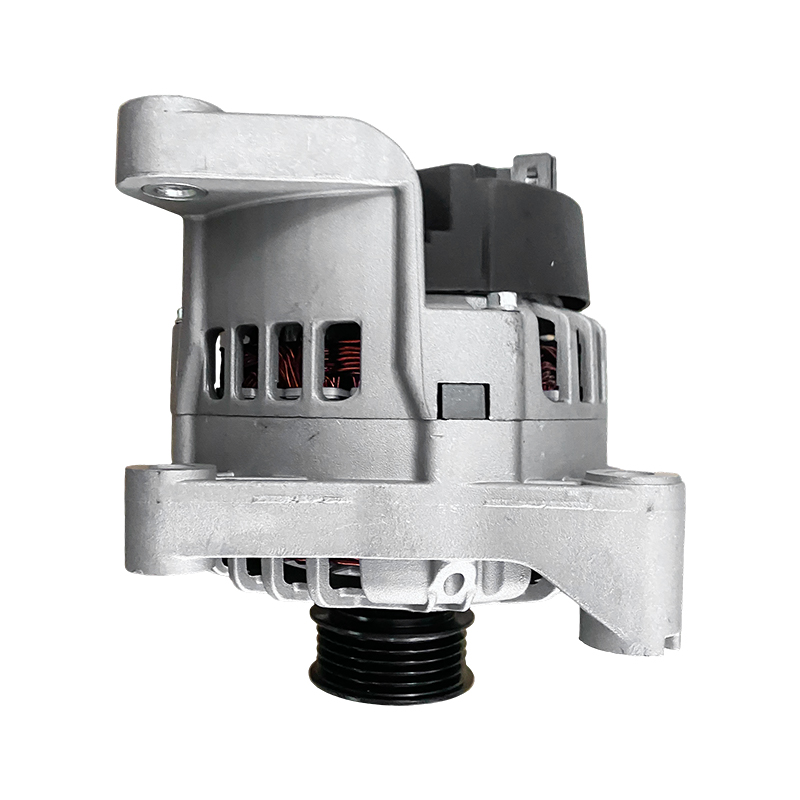 12V 120A 5PK Alternator for BMW E46/E39/E53 and MG ZTLists 12 V, 120 A, 5PK pulley and BMW/Valeo cross-references for E46/E39/E53 and MG ZT fitment.View Product →
As a reference for how much detail a listing needs, our BMW-family unit for E46, E39 and E53 applications is published as 12 V, 120 A with a 5PK pulley alongside its cross-reference numbers — voltage, amperage, pulley profile and OE numbers, not just a model name. The F10 535i uses a different, higher-output machine, and any listing that does not state that difference plainly deserves a second look before you pay. Our own replacement alternator and starter range is organised the same way, by OE reference first.
On the supply side, this is the discipline a replacement-parts factory lives or dies by. The plant behind this site builds starters, alternators, armatures and solenoid switches for the aftermarket and works from OE cross-references rather than a proprietary numbering system; the factory profile sets out its capacity, testing equipment and staffing. That is the same OE-first logic a 535i owner should apply when ordering: identify the unit fitted to the car, match its published parameters, then buy.
A BMW F10 535i is a genuinely good car with a finite electrical service life. Buy one at 150,000 km expecting a battery, a decoupler pulley and eventually a starter, price those items into the deal, and the N55 delivers exactly what the badge promises. Skip that step and the cheapest 535i on the lot usually turns out to be the most expensive one to keep on the road.
Recommended Products
For Exclusive Offers And The Latest Deals, Feel Free To Contact Us!
We will unswervingly implement the tenet of "quality first, customer first, strict management, and creating a famous brand". Professional OEM/ODM Automotive Alternator Manufacturers and Heavy-Duty Truck Alternators Suppliers in China.
Product
Contact Info.
+86-180 5150 2183
+86-0510-83880396
No. 11 QiBei Road, Yuqi Town, Wuxi City, Jiangsu Province, China
 OEM Alternator Supplier Custom Automotive Alternator Truck Alternators Supplier
 English
 Español
 عربى