English

Need Help Now? Call Us!
+86-0510-83880396
Our team proudly offers an on-time guarantee and a 100% customer satisfaction guarantee.
Contact Online


 Home / News / Industry News / BMW E36 vs E46: Which Generation Is Cheaper to Own and Easier to Service?
 2026.10.20
 Industry News
Put a 1997 E36 328i and a 2003 E46 330i on the same lift and the family resemblance fades fast. Same front-engine, rear-drive layout, same multi-link rear axle concept, same straight-six soundtrack — but the parts that fail, the tools required and the cost of putting either car right are different enough that the decision should be made on maintenance, not on styling.
The short answer: the E36 is the simpler and cheaper car to keep on the road; the E46 is the better car to drive and the far more expensive one to neglect. Spend E36 money on a sound shell and a fresh cooling system. Spend E46 money only after a proper inspection and a preventive baseline in the first six months of ownership.
Verdict at a glance
Content
Four differences explain almost every ownership story you will hear about these cars.
The E36 brought the multi-link Z-axle to the 3 Series and weighed roughly 1,380 kg as a manual 328i. The E46 kept the layout, widened the track and added stiffness, plus aluminium front control arms on most six-cylinder cars. The 70–90 kg penalty shows up as slower steering response rather than slower acceleration.
M50 (1991–95), M52 (1996–98), M52TU (1998–2000), M54 (2001–06). Single VANOS became dual VANOS, the throttle cable became drive-by-wire, and displacement grew from 2.8 to 3.0 litres. Peak output rose from 193 hp to 231 hp, but the change you feel is 300 Nm at 3,500 rpm, which makes the E46 pull like a larger car.
An E36 is a small collection of modules plus a 20-pin diagnostic socket under the bonnet. An E46 adds a light control module, a body module (GM5) and an instrument cluster that stores the odometer reading, all reachable through the 16-pin OBD-II port. Better diagnosis, but cluster swaps and mileage discrepancies are a genuine E46 buying risk.
Both use a plastic-impeller water pump, a plastic thermostat housing and a pressurised system that does not forgive air pockets. The E46 adds an expansion tank that cracks along its seam and a DISA valve that rattles with age. Charging demand rose too: 80–90 A was normal on an E36, while a loaded E46 with xenon, heated seats and premium audio justifies the 120 A unit.
Fit the alternator to the car, not to the catalogue. Voltage, rated current, pulley rib count and pulley diameter all have to agree, and the 120 A Valeo-type unit shared by the E46, E39 and E53 runs a 5-rib (5PK) pulley — a 6-rib or oversize pulley will destroy a belt inside a month.
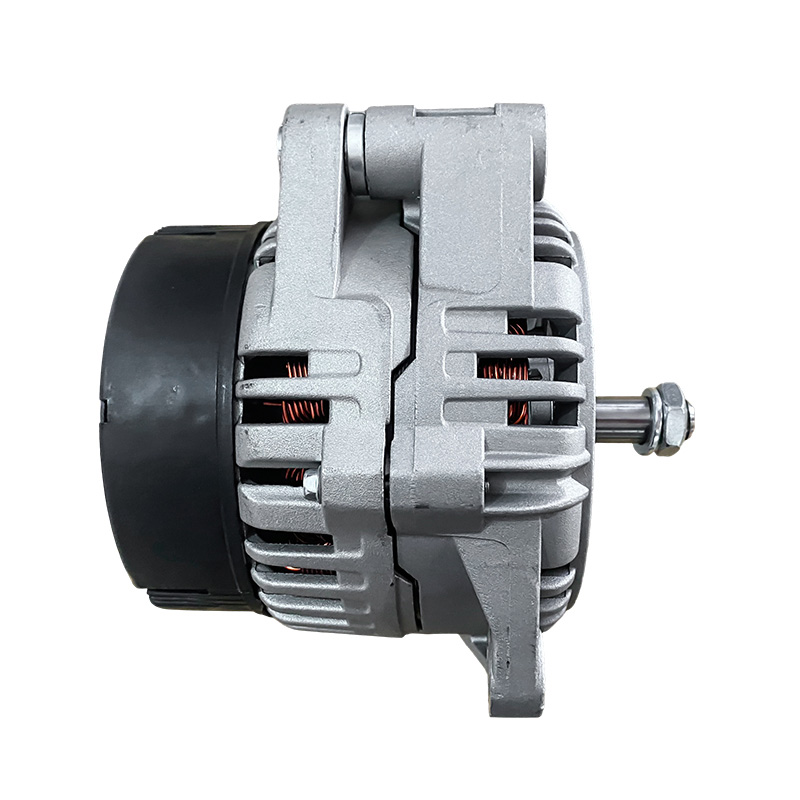
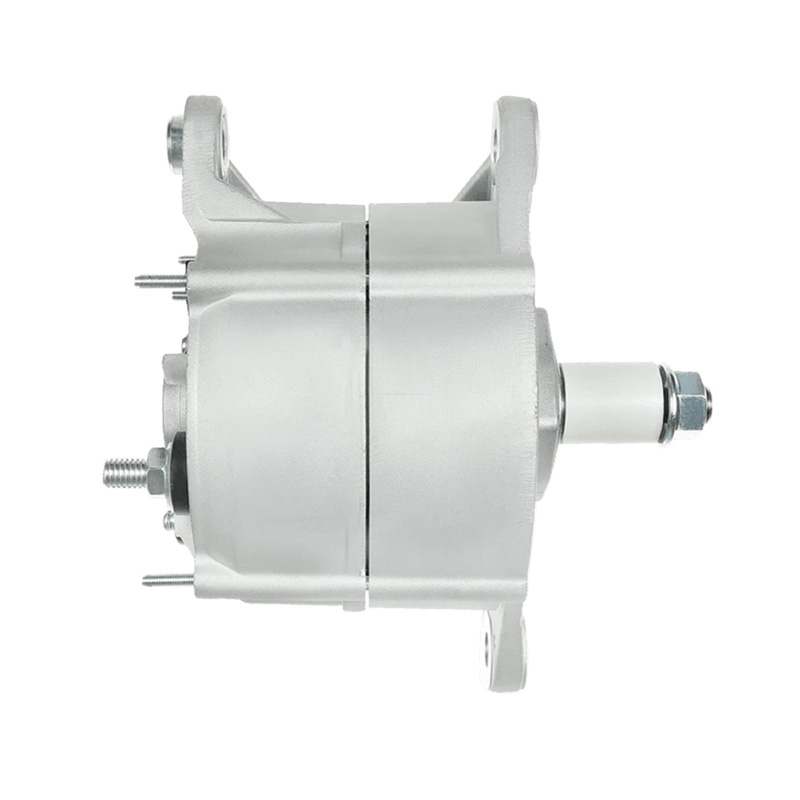
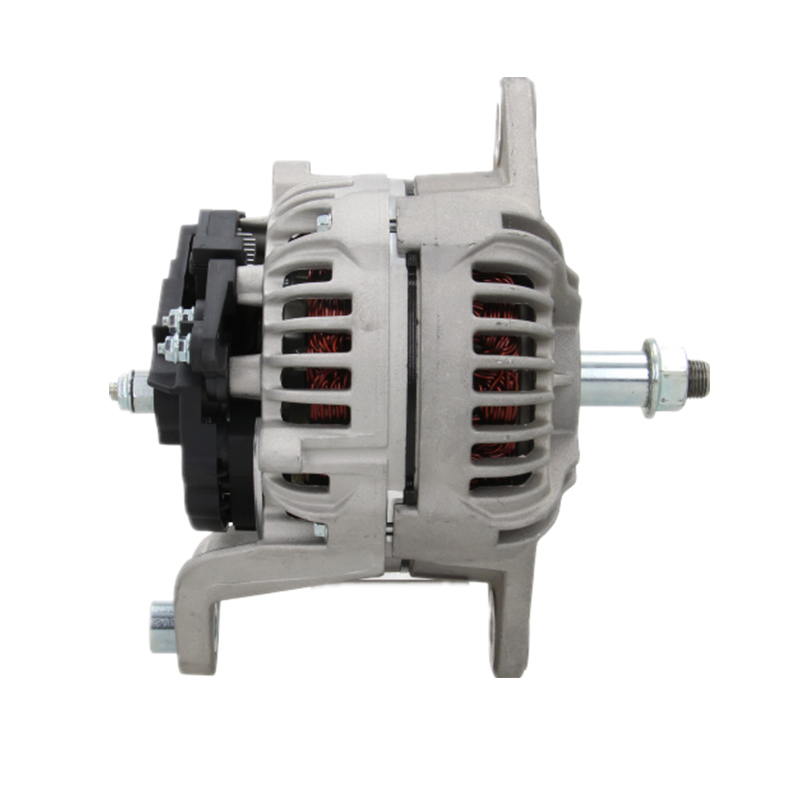
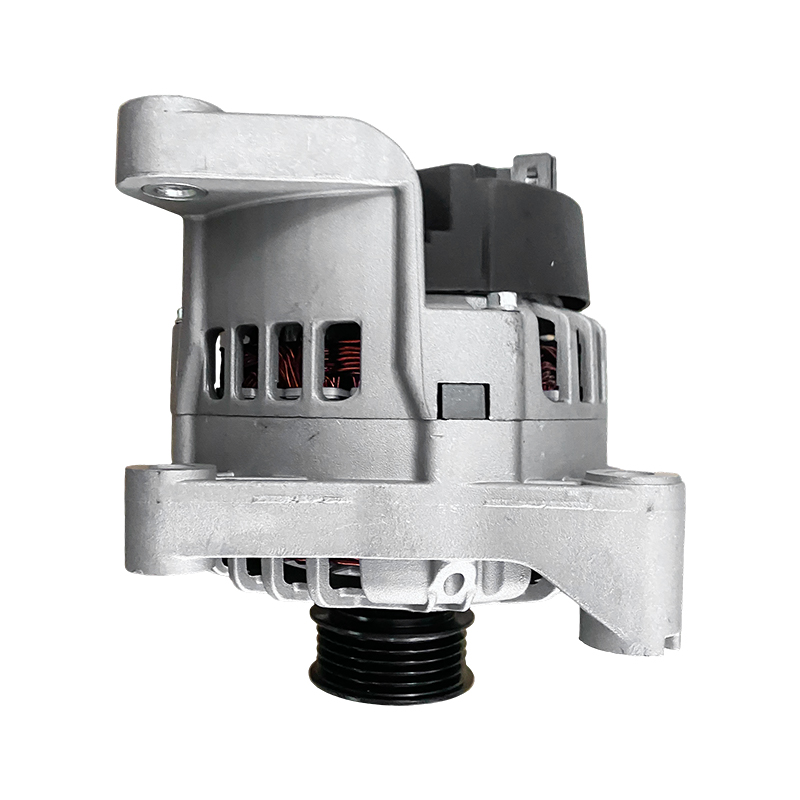 12V 120A 5PK Alternator for BMW E46/E39/E53 and MG ZTDirect-fit 120 A unit with a 54 mm 5PK pulley for listed BMW diesel and MG ZT applications, matching OEM mounting and belt alignment.View Product →
Cranking faults follow a different logic. Check battery health and the engine-to-body earth strap before condemning the motor, then load-test it hot. Older Delco-style and Bosch starters are simple, rebuildable units, and even the newest designs still rely on the same solenoid-and-pinion principle — the evolution is covered in this look at next-generation starter technology.
Numbers alone do not settle the choice, but they explain why the two cars feel different and why the parts bills land in different places.
The bars below are a workshop-style attention index (0–100, higher means more frequent intervention in high-mileage use), not a failure rate. Dark blue is the E36, light blue the E46.
Read it as a budgeting tool: an E36 owner should reserve money for arches, jacking points and rear shock towers, while an E46 owner should reserve money for the cooling system and the VANOS. Both should test the charging circuit before anything else, because a flat battery masks a dozen unrelated faults.
Use case shapes parts demand more than model year does. This is a typical split for the remaining enthusiast-owned population.
Work in this sequence and you will reject most bad cars within the first hour.
Arrive before the seller warms the engine. Listen for VANOS rattle, timing-chain noise and slow cranking, all of which point to money.
Measure at the battery with lights, blower and rear defroster on. Roughly 13.8–14.4 V is healthy; below 13.5 V suggests a tired alternator, regulator or earth strap.
On an E46, read the light module, body module and cluster. Compare the stored mileage with the paperwork; on an E36, a simple fault-code read usually suffices.
Pressurise to the cap rating and watch for seepage at the tank seam, radiator neck and thermostat housing. Any crusty white residue is a warning, not a cosmetic issue.
From below, check rear shock towers, subframe mounting points and trailing-arm bushes. On early E46 cars, look closely at the floor around the rear subframe.
E36 325i or 328i. Baseline refresh costs about 1.0 on a relative index; most jobs need hand tools, a pressure tester and a multimeter.
E46 330i. The same baseline lands near 1.4 on the same index, mostly cooling, VANOS and bushings, but you get torque, brakes and comfort in return.
E36 M3 for mechanical simplicity, a clean late E46 for pace. Either way, buy on documentation and originality, not on a fresh respray.
Most replacement electrical parts for these cars are still built by independent specialists rather than by BMW itself, and the fitment logic is identical: a part number plus voltage, current and pulley data. A look at the factory profile behind one such supplier shows how that matching work is organised.
Choose the E36 if you want the cheapest route into a rear-drive straight-six and you are willing to inspect structures and refresh plastics. Choose the E46 if you want the better car and can pay for the cooling and electrical baseline it demands. Both reward the buyer who tests the charging system before falling in love with the paint.
Recommended Products
For Exclusive Offers And The Latest Deals, Feel Free To Contact Us!
We will unswervingly implement the tenet of "quality first, customer first, strict management, and creating a famous brand". Professional OEM/ODM Automotive Alternator Manufacturers and Heavy-Duty Truck Alternators Suppliers in China.
Product
Contact Info.
+86-180 5150 2183
+86-0510-83880396
No. 11 QiBei Road, Yuqi Town, Wuxi City, Jiangsu Province, China
 OEM Alternator Supplier Custom Automotive Alternator Truck Alternators Supplier
 English
 Español
 عربى