English

Need Help Now? Call Us!
+86-0510-83880396
Our team proudly offers an on-time guarantee and a 100% customer satisfaction guarantee.
Contact Online


 Home / News / Industry News / Lucas RM Alternator Replacement: Model Guide, Failure Signs & OEM Selection
  2026.06.22
 Industry News
The Lucas RM alternator powered British motorcycles and classic vehicles for three decades. Most of that production ended by the early 1980s, and the original 6-volt unregulated units have been out of manufacture for far longer. What remains is a large global base of restored and maintained vehicles that need working charging systems — and a replacement parts market where the quality gap between suppliers is significant.
For workshops, restorers, and fleet operators sourcing Lucas alternator replacements for classic and commercial vehicles, understanding the RM model family and what a correct replacement requires is the difference between a charging system that runs reliably for another decade and one that fails within a season.
Content
Classic British motorcycles — Triumph, BSA, Norton — have seen sustained collector and restorer interest across Europe, North America, and Australia. The same is true of vintage British commercial vehicles. As these machines return to the road, their electrical systems require attention. The original Lucas RM alternator components are aging: rotors lose magnetism over decades of storage, early open-wound stators develop insulation failures from vibration, and the zener diode regulation systems that Lucas used through the 1970s are no longer adequate for modern accessories, electronic ignitions, and sealed batteries.
Original Lucas stator and rotor assemblies for the older 70mm rotor variants are no longer manufactured. The market has moved to replacement units built to OE specifications, with some designs updated to address known weaknesses in the original construction — encapsulated windings instead of open coils, for example, and higher output ratings that support 12-volt operation more reliably than the original 6-volt designs.
The result is consistent demand for quality RM-series replacement alternators that fit without modification and deliver stable output across the RPM range where these engines actually operate.
Several failure modes are specific to the RM design and recur predictably on machines that have been stored or lightly used over many years.
On machines that have been stored for years, it is worth treating the rotor and stator as presumptively worn rather than waiting for a fault to confirm what the age of the components already suggests.
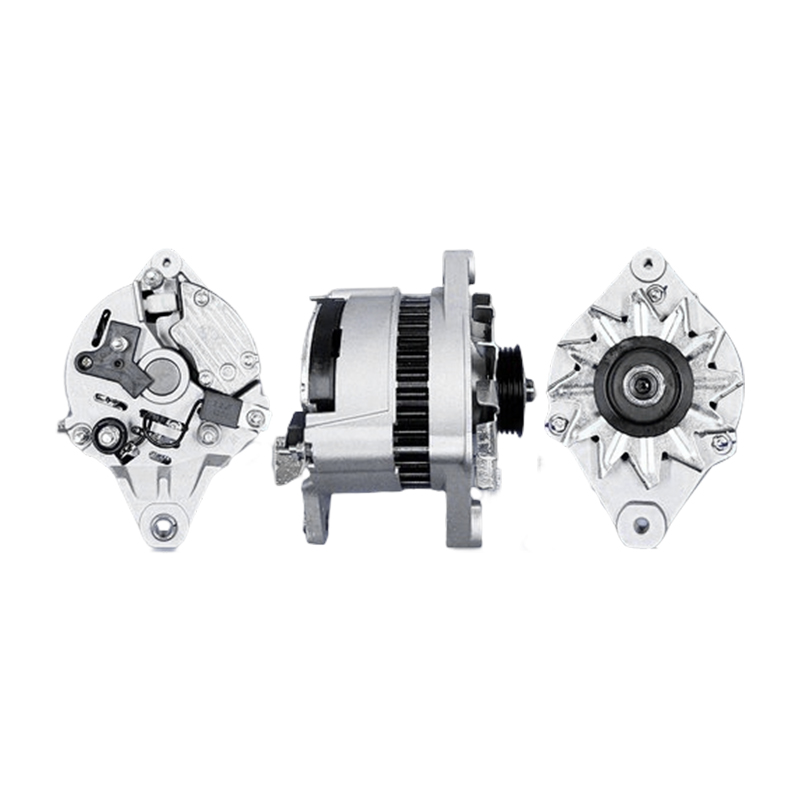
The RM series covers a range of models with different frame shapes, rotor diameters, output ratings, and voltage configurations. Getting the replacement right requires matching the mounting pattern and rotor size, not just the model number.
| Model | Frame | Rotor Diameter | Output | Voltage | Replacement Note |
|---|---|---|---|---|---|
| RM12 / RM14 | Hexagonal | 70mm | ~60W | 6V | No longer manufactured; requires adaptor for round-frame swap |
| RM13 / RM15 | Round | 70mm | ~60W | 6V | No longer manufactured; insufficient output for modern regulation |
| RM18 | Round | 74mm | ~100W | 6V / 12V | Direct swap with RM21/23; solid-state regulator strongly advised |
| RM19 / RM20 | Round | 74mm | ~120W | 6V | Encapsulated windings; can be regulated to 12V with regulator rectifier |
| RM21 | Round | 74mm | ~120W (10A) | 12V | Standard 2-wire single-phase; interchanges with RM18, RM19, RM23 |
| RM23 / RM27 | Round | 74mm | ~200W (16A) | 12V | High-output single-phase; same bolt pattern as RM18–RM21 |
| RM24 | Round | 74mm | ~180W | 12V | 3-phase, 9-pole; more power at low RPM; not recommended for 6V regulation |
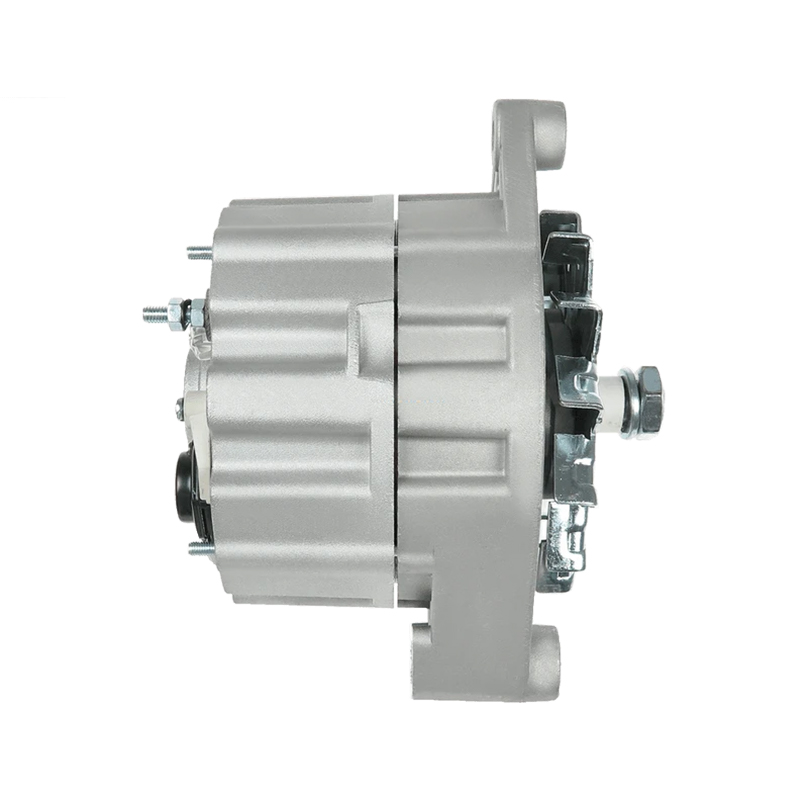
The RM18 through RM27 single-phase models share the same 74mm rotor and round mounting pattern, making them interchangeable without engine case modifications. The RM24 uses the same physical dimensions but its 3-phase stator produces substantially more usable power at low and mid-range RPM — a meaningful advantage for electric-start machines and any motorcycle that spends time at urban speeds. For applications requiring stable current across a wide RPM band, the RM24 replacement is the preferred upgrade over the older single-phase units.
For vehicles originally fitted with Lucas alternators in automotive applications, such as the 12V 55A Lucas alternator for Ford Escort and Transit applications, OE-specification replacement units are available with matched output ratings and direct mounting compatibility.
A replacement stator or rotor alone does not address the most consequential weakness in the original Lucas charging system. The zener diode regulation used from the 1960s onward was a functional solution for its era, but its limitations are incompatible with the electrical components found on restored and modernized vehicles today.
The core problems with zener regulation are well established. Regulated voltage rises as the diode heats up — what starts as 13.5V can reach close to 16V under normal operating conditions, overcharging any battery in the system. Two closely matched diodes are required to handle full alternator output, and matching degrades over time. Most critically, if a zener diode fails open-circuit, the full unregulated alternator output reaches the battery and every connected component. A single diode failure on a machine with electronic ignition, a sealed AGM battery, or LED lighting will destroy those components within seconds.
A solid-state regulator rectifier eliminates all of these failure modes. It combines the rectification function of the original mechanical rectifier with proper voltage regulation, holds output within a stable band across the RPM range, and is fail-safe by design. For any Lucas RM alternator replacement, fitting a correctly rated solid-state regulator rectifier alongside the new stator and rotor is not an optional upgrade — it is the only configuration that protects modern electrical components and delivers reliable long-term operation.
The replacement Lucas alternator market includes a wide range of product quality. For buyers sourcing units for fleet restoration, workshop stock, or export, the differences between a correctly manufactured replacement and a low-cost imitation become visible quickly — usually within the first season of use.
Key indicators of a quality OEM replacement unit:
Wuxi Sanyou Auto Electrical Factory manufactures Lucas alternator replacement units built to OE specifications, covering automotive applications across Ford, and supplying workshops and distributors in Europe, North America, and beyond. All products are manufactured under ISO9000 and IATF16949 quality systems, with full cross-reference documentation available on request.
Recommended Products
For Exclusive Offers And The Latest Deals, Feel Free To Contact Us!
We will unswervingly implement the tenet of "quality first, customer first, strict management, and creating a famous brand". Professional OEM/ODM Automotive Alternator Manufacturers and Heavy-Duty Truck Alternators Suppliers in China.
Product
Contact Info.
+86-180 5150 2183
+86-0510-83880396
No. 11 QiBei Road, Yuqi Town, Wuxi City, Jiangsu Province, China
 OEM Alternator Supplier Custom Automotive Alternator Truck Alternators Supplier
 English
 Español
 عربى
عربى